

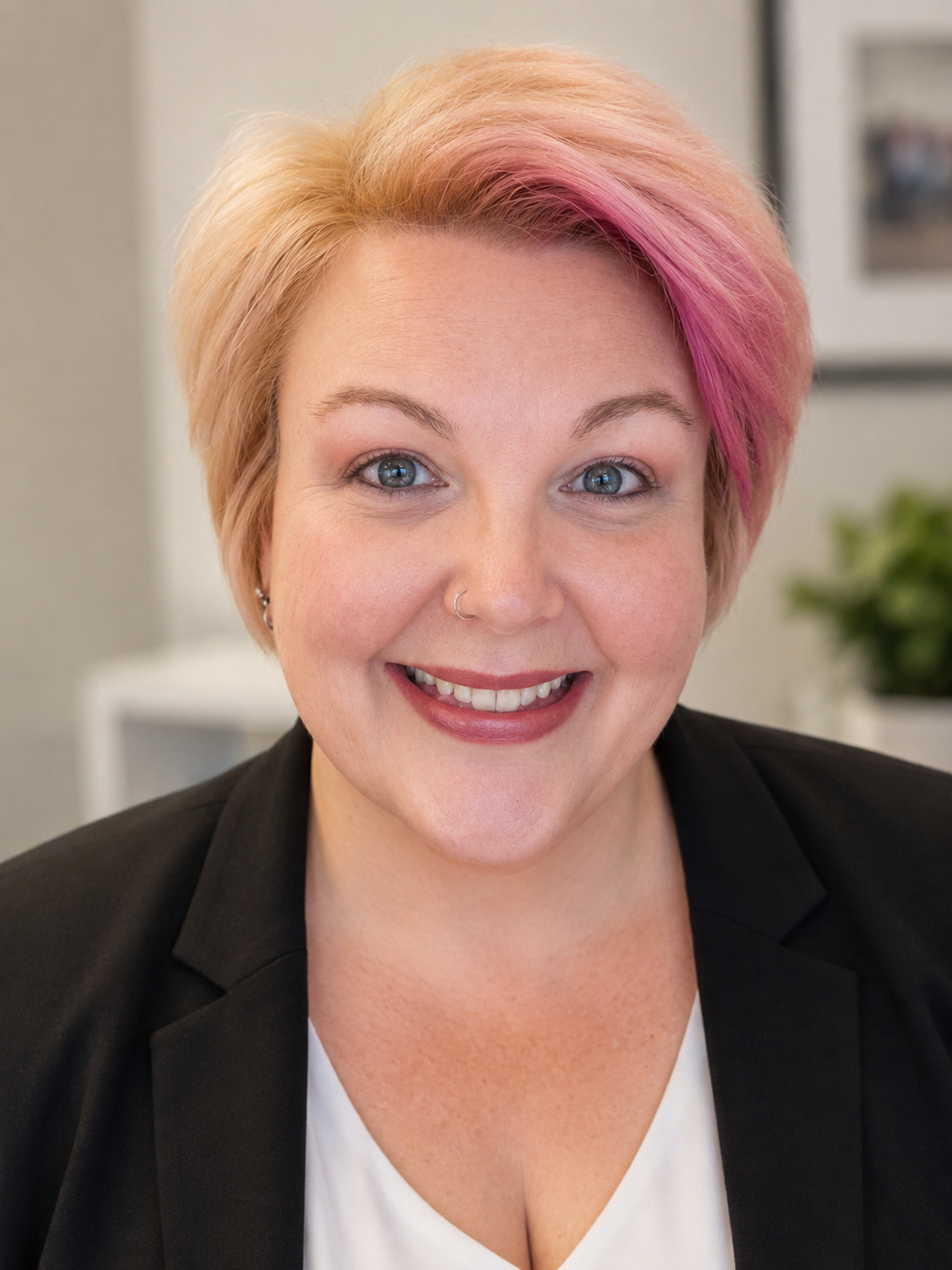
I'm Amanda Sullivan.
I've been designing learning for adults for 28 years, and most of that time I was doing it without a roadmap, without a supervisor who understood the work, and without resources built for someone in my exact position. So I built what I needed. BrightBow is what that looks like when you formalize it.

Who I Am
I hold a B.S. and M.S. in Education. I'm a certified ELA teacher, K-12 Library Media Specialist, reading specialist, and system administrator. I've spent my career in public education in nearly every seat a K-12 building offers, classroom teacher, school librarian, instructional coach, district-level specialist, data systems lead, and learning experience designer. I've designed and delivered professional learning for individual teachers, full PLCs, district-wide cohorts, and online audiences. I've received grants and funding that supported the learning of thousands of practitioners over nearly three decades.
What that background gave me isn't a credential list. It's pattern recognition. I've been in the room when learning worked and when it didn't, and I've spent a long time understanding why those two outcomes aren't random.
What BrightBow Is
BrightBow is a learning design studio. It exists for the people who design and lead learning for other adults, and for the educators doing that work every day inside institutions that don't always make it easy.
Everything here is grounded in adult learning theory, because adults learn differently than children do. That difference deserves better design than it usually gets. The research that supports this work comes from Knowles, Baldwin and Ford, Immordino-Yang, Willis, and others who've spent serious time understanding how adults actually change. BrightBow takes that research and connects it to practice in a way that's honest about what it confirms and what it doesn't resolve.
BrightBow isn't a content library and it isn't a collection of templates. It's a learning design studio built from real problems, tested in real conditions, and organized into something you can actually use.
The Three Destinations
In the Workshop
The Workshop is the intellectual center of BrightBow. It's the ongoing work of connecting adult learning research to practice, organized by topic and built in layers so you can go as deep as the idea requires. It's not a resource collection; it's a place where serious thinking about adult learning lives in public, because understanding the research is where better design starts. If you've ever wanted to know what the research says this is where that conversation happens.
In the Studio
The Studio is built for learning designers, facilitators, instructional coaches, and online course creators: the people responsible for designing learning experiences that actually hold up after the session is over. Every Studio course is grounded in the adult learning architecture I've spent building and refining. They're designed to give a clearer, more grounded understanding of how adults actually learn, so that the work reflects what learning science says rather than what tradition keeps repeating.
In the Wild
The Wild is for the educators in the building. Not the ones being trained, not the ones running the session, but the ones navigating a Tuesday afternoon in a public school when nothing is going the way it was supposed to and everyone needs something from you at once. Wild Kits don't instruct. They acknowledge. They're funny because they're true, and they exist because sometimes what you need isn't a framework, it's proof that somebody else saw the same absurdly true thing and had to write it down.
Adults don't come into a learning experience empty. They come in carrying years of experience, professional context, and strong opinions about whether what they're being asked to learn has anything to do with their actual work. Those opinions aren't resistance. They're information, and learning that ignores them doesn't get very far.
When learning is designed well, people don't always recognize it as different in the moment. What they notice is what happens afterward, when the idea surfaces in a real decision, or a new practice shows up in their work in a way that feels natural rather than forced. That's what it means to design for transfer rather than just delivery, and it's the standard every BrightBow resource is built toward.